Essay--Bioshock
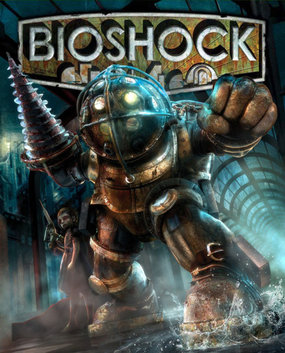 Folks that didn't grow up with a console controller in their hands might be unaware of the truly innovative narratives that come along with some of the better video games. While most games' narratives are flimsy, artificial, and frequently nonsensical, there are many that handily destroy that generalization.
I know I’ve mentioned Dead Space before and how integral it was to the development of The Derelict Saga for me, but I never really touched much on the story elements there, which involved a conspiracy lying beneath a fanatical religious cult. The cult, as all cults seem to, mainly served its masters while fleecing its followers. In the case of Dead Space, the fleecing and manipulation were sadly the least of the evils going on behind the scenes.
While Dead Space takes place in the far future, there are other games that take place in the near past or near future, providing alternate realities that take so much from our own time and history and twist them into nearly unrecognizable forms. The Bioshock series might be the best example of dealing with the fallout from WW2, the ennui that developed as a result of the beginning of the Cold War, and, of course, sparring ideologies.
I’m not going to discuss the protagonists of the game because in my mind, they are merely vehicles to travel through the wreckage of a once utopic society. Instead, I want to talk about the wreckage itself.
In Bioshock, a super wealthy individual named Andrew Ryan decides that the surface world, post WW2, is now ruled by people who would force him to pay taxes, limit his research on human beings, and require certain labor laws to be followed, is inhabitable for him and for like minded folks. In short, he is an objectivist, a philosophy most associated with followers of Ayn Rand. With that in mind, he builds Rapture in the early fifties, a subsurface ocean city of impossible beauty and technology. All are welcome. No racism, no elitism, all are welcome so long as they wish to work and build a community.
The finest scientific minds not only aided in Rapture’s construction, but stuck around to perform research and live without oversight. For science, Rapture was truly a utopia. All inventions were recognized, inventors were paid handsomely, there was no governmental or ethical oversight, and a great economy was forged on those continual advancements.
Twenty years later, Rapture is a decaying, leaking city whose denizens have become all but unrecognizable as human beings. They have partaken in so many of Rapture’s genetic products that their forms have changed, their minds polluted, and they no longer recognize any law except the basest of natural law—kill or be killed.
So what the fuck happened? Well, to be perfectly cynical, humans.
In any city, there are multiple castes. There are those that run it, those that produce for it, and those that service it. In simple terms, it’s a pyramid and typically the “lower” layer is paid less, lives in less ideal conditions, and are locked out of many of the incredible city’s amenities for lack of cash. This new utopia grew slums. This new utopia started having difficulties in maintaining its structures because people didn’t want to work for starvation wages.
Once things got hard, racism, classicism, and all the “isms” this utopia was meant to put an end to resurfaced. Rapture’s creator seemed oblivious to the situation, or perhaps his own ideals prevented him from taking action to stop the decay. Ultimately, however, the city’s undoing was from politics.
A charismatic leader, Sofia Lamb, emerged to lead the lower castes against the upper. She championed collectivism versus Ryan’s pure objectivism and the two philosophies were violently at odds with one another. There were public debates, assassination attempts by Ryan against Lamb, and ultimately, a civil war of sorts, that left Lamb in charge of a broken, genetically perverted society of insanity and, most terrifying of all, a complete lack of compassion for human life. In a way, Lamb ended up creating the perfect capitalistic society—survive or die.
In a way, Rapture’s history is an indictment of both orthodox capitalism and orthodox communism. Neither can possibly succeed because orthodox capitalism ultimately leads to more and more people falling out of the upper castes and into the lower. Once a certain percentage level is reached, things become untenable. It only takes a spark (like Karl Marx, for instance) to rally the “peasants” to take back what they’ve lost in the service of their “betters.”
The communist revolution in Russia was hardly unique. The French Revolution, for instance, forecasted the fall of the Russian Monarchy, and all the other monarchies across Europe. In each case, someone rose to lead the masses, to stoke their righteous indignation, and encourage them to shake off their bonds (real or imaginary). Once enough people, materials, and resources are acquired, it’s game on. Or end game, depending on how you want to think about it.
Did the “evil” monarchies come to an end? Absolutely. What took their place, however, was just as bad, and in some cases, worse. Why? Because the cults of personality that lead these kinds of socio-economic revolutions make terrible leaders and always have. More importantly, a cult of personality always wants to be “the leader” regardless of their capacity to actually manage the peace once the war is over. Through corruption, coercion, loyalty oaths, and threats, the cult of personality attempts to consolidate and maintain their power. Ultimately, it fails.
Lenin, Stalin, Ho Chi Minn, Mao Zedong, Pol Pot, Ayatollah Khomeini, were all terrible stewards to their populace after the fall, their economies, and their country’s futures. To hold power, many of these regimes still resort to methods that would have made some of their monarchy formers blanche in disgust.
Yet those regimes inevitably fall apart as well. As the world changes, economies change, and technology continues pushing forward, the old ways no longer cut it. The people can no longer make enough money to live or do what they want to do and without opportunities for better jobs, better education and the like, it all falls apart.
In China, for instance, most of the young people have abandoned the rural areas where corrupt apparatchiks steal their wages and govern the areas with an iron fist. This is unsustainable, obviously, and I’ve no doubt someone in that country, not to mention in America itself, has already thought about starting a new agricultural program where political/criminal prisoners are responsible for cultivating the country’s food supply. Without pay. Without a chance at freedom. Basically, they become slaves. Need more slaves? Find more “criminals” to incarcerate.
The social revolution in china led to the imprisonment, torture, and deaths of most of the country’s scientific minds and teachers as they were put on trial for education being against “communist” ideals. Decades later, China has recovered from that, but it’s only a matter of time before it happens again. Considering the current tech crackdown going on, I’d say the new social revolution is already under way. It won’t be the same, however—China now has too much to lose, but I guarantee the Party will take whatever steps necessary to maintain control, even if that means plunging their economy into hell.
Sadly, China is not the only example here, merely the largest by population that I know of. India, however, can’t be far behind. As one of my fellow writers from Sri Lanka pointed out, the talented engineers and scientists are abandoning their autocratic homelands for opportunities abroad. The more corrupt the country’s government, the more likely these folks are to bail. Again, this is unsustainable. Once the tool makers leave or die out, a society is in deep trouble.
Those considerations aside, what I love most about the Bioshock series is that it forces you to examine this conflict of economic and governing philosophies from all sides through audio diary entries left behind by Ryan, Lamb, as well as scientists, intellectuals, every day people, as well as their children. All this while the player character fights for their very survival.
If there is a lesson to be drawn from Bioshock and its sequels, it’s that moderation is key. You can’t have a purely objectivist society or a collectivistic one once a certain population percentage is reached. Why? Because humans are humans. We covet, we complain, and we blame others, rightly or wrongly, for our plights. It’s an (un)fortunate part of our nature.
We have now reached the age of civilization where planned communities are leading to so-called “privately” planned cities which are owned and run by corporations with their own constitutions, own security forces, and their very own infrastructure. Lavasa, India, for instance, while providing a great alternative to the existing Indian cities, promises more than it can deliver to the average citizen.
These cities are expensive, elitist, and their infrastructures are suffering because of the expense and elitism. It’s difficult to find workers if they can’t afford to live in the very city they service, much less feel welcome there.
If you do a little searching, you’ll find that Lavas is only one of dozens of these. There are several billionaires buying up land in states and other countries to create their own visions that will be controlled and governed by corporations.
Great idea, I guess. However, without a democratic government run by its citizens, and instead run by a corporation unaccountable to anyone, I don’t see this being viable long-term for many of the same reasons Rapture fell.
Bioshock doesn’t present an argument about communism versus capitalism, or even objectives vs collectivism. It’s about the evils of fanatical devotion to either end of the spectrum. Without a sense of moderation, either ultimately descends into unhealthy and often violent authoritarian dictatorships surviving in the war-torn aftermath.
Bioshock is available on pretty much all platforms, has amazing art, great story lines, and fantastic gameplay. Don’t want to play? Go to YouTube and find one of the many playthroughs. Immerse yourself and witness the crazy. Or perhaps purchase and read one of the books. Regardless, Bioshock might make you examine your own beliefs and that alone makes it worth your time.
Become a patron and get access to published and unpublished books voiced by the author!